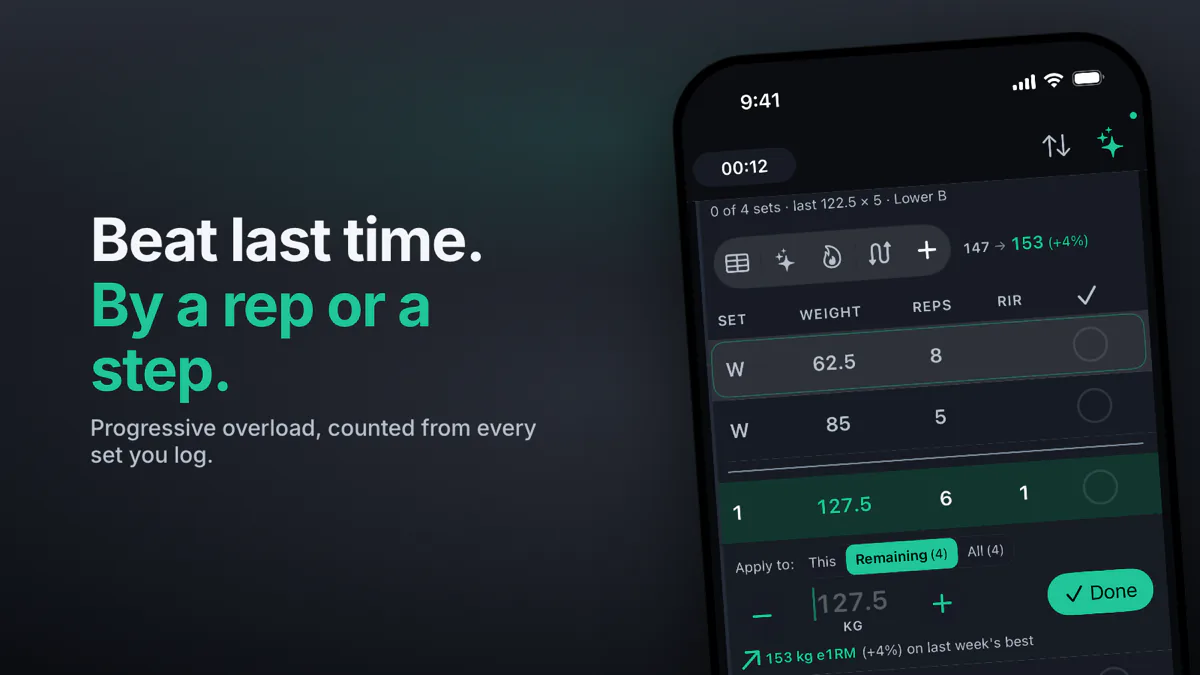
Progressive overload means gradually increasing the stress placed on the muscles so they keep adapting. The American College of Sports Medicine's 2026 position stand, built on 137 systematic reviews and more than 30,000 people, says healthy adults should do progressive resistance training. Its 2009 stand put the jump in load at 2 to 10% once you can do one to two reps over target. In an 8-week trial of 55 untrained women, arms that added load grew 22.9% in triceps thickness against 11.6% for arms that never did (Kassiano 2026).
What is progressive overload?
A muscle adapts to what it is asked to do, so the ask has to keep rising for the adaptation to continue. Four things make up that ask in a normal program: reps and weight on each set, hard sets per week, how close each set ends to failure, and recovery between sessions. For most lifters, progressive overload means pushing the first one up a little at a time and keeping the other three in range.
What does the ACSM say?
The 2026 position stand (Currier and colleagues, Medicine & Science in Sports & Exercise) is an overview of 137 systematic reviews and more than 30,000 participants. It updates the college's 2009 stand, and its main finding is that few prescription variables affected the main adaptations. Four statements matter for overload:
- Healthy adults should perform progressive resistance training. The stand does not define progression as adding load every session.
- Strength was enhanced by heavier loads (80% of 1RM or more), a full range of motion, 2 to 3 sets and at least 2 sessions a week.
- Muscle size was enhanced by higher volume (10 or more sets a week) and eccentric overload.
- Training to momentary muscle fatigue, set structure, time under tension and periodization did not consistently change outcomes.
The 2009 stand gave the progression rule itself: when training at a specific rep-max load, raise the load 2 to 10% once you can do one to two reps over the target. It recommended 8 to 12 reps for novices and a wider range for experienced lifters.
Other posts here cover the pieces. Training to failure finds failure optional, sets per muscle per week puts a solid range at 10 to 18 hard sets, and double progression is a close relative of the 2009 rule, written as a loop.
Does progressive overload matter?
It roughly doubled growth in one trial of untrained women, and arms that never progressed still grew. Two 2026 trials, both in untrained people, show it. Kassiano and colleagues (Medicine & Science in Sports & Exercise) trained 55 young women for 8 weeks, each arm assigned at random. Both arms did three sets of 8 to 12 elbow extensions, three times a week. One arm added load whenever it reached the top of the range. The other never changed. Triceps thickness rose 22.9% in the progressing arm and 11.6% in the arm that never added load, against 1.8% in a no-exercise control. The arm without progression gained about half as much. Even so, the authors conclude that training without progression is enough to grow muscle in untrained young women, and they leave longer-term effects open.
Ferrari and colleagues (International Journal of Sports Medicine) ran a 12-week trial in 31 untrained adults, one leg progressing and one not. Both legs gained muscle, and the gap opened late: the progressing leg grew more between sessions 18 and 24 (a difference in cross-sectional area of 1.22 square centimetres, 95% CI 0.59 to 1.84). The trial does not test why, but effort is a likely reason. The progressing leg stayed near failure: 0.47 reps in reserve at the start, 0.20 at the end. The fixed-load leg drifted from 1.50 to 4.08, so by the end its sets finished much further from failure.
On the leg that never added load, the same sets ended further and further from failure.
Both trials used untrained people on one exercise, so they show a direction and say little about size in experienced lifters. No trial cited here compares progressing with not progressing in trained lifters.
What is an example of progressive overload?
Take a bench press with three sets and a range of 8 to 12 reps, trained once or twice a week. This is an illustration for a novice or intermediate lifter on a compound lift, not data. The reps climb across six sessions, and then the weight moves.
| Session | Weight | Reps per set | What happens |
|---|---|---|---|
| 1 | 60 kg / 132 lb | 8, 8, 8 | Start at the bottom of the range |
| 2 | 60 kg / 132 lb | 9, 8, 8 | Reps climb where they can |
| 3 | 60 kg / 132 lb | 10, 9, 9 | Reps keep climbing |
| 4 | 60 kg / 132 lb | 11, 10, 10 | Reps keep climbing |
| 5 | 60 kg / 132 lb | 12, 11, 10 | One set is at the top |
| 6 | 60 kg / 132 lb | 12, 12, 12 | Every set at the top of the range |
| 7 | 62.5 kg / 138 lb | 9, 8, 8 | A jump of about 4%, inside the ACSM's 2 to 10%. The climb starts again |
Example only: bench press, three working sets, range 8 to 12 reps, weights in kilograms and pounds.
What does a progressive overload workout look like?
Any workout where each exercise has a rep range, a target effort and a rule for when to add weight. One session might read like this:
| Exercise | Sets and range | Target | Add weight when |
|---|---|---|---|
| Bench press | 3 x 8 to 12 | 2 reps in reserve | The last set reaches 12 at 2 reps in reserve |
| Chest-supported row | 3 x 8 to 12 | 2 reps in reserve | The last set reaches 12 at 2 reps in reserve |
| Lateral raise | 3 x 12 to 20 | 1 rep in reserve | The last set reaches 20 at 1 rep in reserve |
Example only, in Povver's convention: reps in reserve (RIR) is how many reps you had left when the set ended.
What are the levers?
| Lever | What to do | What the evidence says |
|---|---|---|
| Reps, then weight | Add reps at a fixed weight until the last set reaches the top of the range, then add weight | Adding reps grew muscle about as well as adding load in 43 trained lifters over 8 weeks (Plotkin 2022) |
| Hard sets | Keep weekly hard sets per muscle inside a range, and add sets only when reps and weight stall | 10 to 18 weekly hard sets is a solid range, and returns fall past 18 (Pelland 2026) |
| Effort (failure, RIR) | Stop most sets one to three reps short of failure | No significant difference between failure and stopping short in 15 studies (Grgic 2022), though muscle grew more the closer sets ended to failure in an exploratory meta-regression (Robinson 2024) |
| Recovery | End blocks with an easier week rather than a week off | A week of no training mid-block added no muscle and cost some lower-body strength in 39 people (Coleman 2024) |
| Measurement | Track each lift's estimated 1RM per week and read the trend, not one session | In 46 women's bench press, Epley averaged within 0.5% of a tested max at 10 reps or fewer (Mayhew 2008) |
Trials and reviews in healthy adults, mostly untrained or recreational lifters, as cited in each linked post. Povver's judgment, not a finding of the studies: the one-to-three-reps-short range, the easier-week advice, the weekly 1RM trend and the order of the rows.
How often should you add weight?
When the lift says so, not on a calendar. The 2009 stand's trigger is performance: one to two reps over the target. The example above took six sessions, and a heavier lift or a narrower range takes longer. Over a career, drug-tested raw lifters gained a median 4% between meets a year apart, and less every year (How fast do lifters get stronger?). Povver, a strength training app, adds weight after one session in which every working set is finished and the last set reaches the top of the range at the planned effort. It sizes the jump from the reps you had left. Double progression has the thresholds and the step sizes.
In what order should you use the levers?
We found no study that ranks the levers, so this order is Povver's own. Reps and weight go first, since the sets are already in the plan. Then hard sets, with effort as the check on both and recovery as the limit on all of them.
Povver, a strength training app, works in that order by its own convention. It raises the rep target while sets stay inside the range, adds weight once the last set reaches the top at the planned effort, and counts hard sets per muscle against a range. It leaves the weight alone while a lift's estimated 1RM is trending down, and ends each block with a deload. How it works has the thresholds.
How do you track progressive overload?
Log weight, reps and reps in reserve for every working set, and read the log lift by lift rather than session by session. One set is noisy: lifters misjudge reps left by about a rep (Halperin 2022, RPE vs RIR), and a bad night just looks like a short set. The weekly estimated 1RM from your best set evens that out. Povver labels a lift climbing, maintaining or declining once three of the last six weeks have an estimate (1RM formulas). In Povver's judgment, a lift that stays flat while its sets get easier is ready for more load.

What if the weight will not go up?
Povver's judgment: try three things before giving up on the lift. Take a smaller step, like fractional plates or the next dumbbell. Keep adding reps past the top of the range, as Povver does on light lifts, until the heavier weight still leaves you inside it. Or add a set, if weekly hard sets for that muscle sit under the 10 to 18 range. Whichever you pick, count reps the same way every session, with the same depth, pause and reps in reserve. Otherwise the climb can be just looser reps.
Can an AI do progressive overload for you?
Partly, and it works best when the numbers are worked out first. The studies so far test something narrower: an assistant designing a plan from a prompt. Washif and colleagues (Biology of Sport, 2024) asked GPT-3.5 and GPT-4 for 12-week programmes for hypothetical lifters and found they likely needed fine-tuning before use. In Havers and colleagues (Biology of Sport, 2025), 10 coaches rated plans from GPT-3.5 and Google Gemini against 27 criteria and judged overall quality moderate. Those models date from 2023 and April 2024, and newer ones were not tested. We searched PubMed and the web in October 2026 and found no study that gives an assistant a real training log and asks it to progress the lifts.
Povver is built for that gap. In its design, progressive overload is mostly arithmetic on your own log: this week's best set against last week's, hard sets against a range, reps left against a target. Povver does the counting and the trend. Through Povver's connector, Claude reads the result, which is set-by-set history, each lift's trend and weekly hard sets per muscle, so it can explain and adjust a plan without computing any of it. Connect Claude to your workout log shows one conversation on an example log.
What have the studies not tested yet?
Trials cited here cover untrained people over 8 to 12 weeks. Still open: whether progression matters as much in trained lifters and over years, which range of reps in reserve is best (the studies do not name one), and how an assistant does when it must progress a real training log.
Last reviewed 17 October 2026. Cite as: Povver, "Progressive overload: how it works and how to apply it", povver.ai/blog/progressive-overload, 2026.
Progressive overload: common questions
What is progressive overload?
Progressive overload is raising what a lift asks of the muscle over time so it keeps adapting. In practice that means adding reps, then weight, within a workable number of hard sets, at an effort close to failure. The American College of Sports Medicine's 2026 position stand says healthy adults should perform progressive resistance training.
Does progressive overload build more muscle?
Roughly twice as much in one 2026 trial, and somewhat more in another, both in untrained people. Arms that added load at the top of the rep range grew 22.9% in triceps thickness against 11.6% for arms that never added load over 8 weeks (Kassiano 2026), and a leg that progressed grew more in the last weeks of a 12-week trial (Ferrari 2026). Training without progression still grew muscle in both, and no trial cited here tests this in trained lifters.
How do you apply progressive overload?
Add reps at a fixed weight until your last set reaches the top of the rep range, then add weight and start the range again. The American College of Sports Medicine's 2009 stand puts the jump at 2 to 10% once you can do one to two reps over the target. Keep weekly hard sets per muscle inside a range, stop most sets one to three reps short of failure, and plan easier weeks.
How often should you increase the weight?
When every set reaches the top of your rep range, or when you can do one to two reps over the target, not on a fixed schedule. The American College of Sports Medicine's 2009 stand sets the trigger at one to two reps over the target and the jump at 2 to 10%.
Do you have to add weight every session?
No. Adding reps grew muscle about as well as adding load in 43 trained lifters over 8 weeks (Plotkin 2022), so reps can climb for several sessions first.
How many sets do you need?
About 10 to 18 hard sets per muscle group per week is a solid range for muscle growth, and 4 is the smallest dose with detectable growth (Pelland 2026). The American College of Sports Medicine's 2026 stand puts the benefit at 10 or more sets a week. Past 18, each extra set adds less.
What if you stop progressing?
Check effort first. If sets have drifted well short of failure, the load can rise. If reps and weight are both stuck, take a smaller step, keep adding reps past the range, or add a set, and read the lift's weekly estimated 1RM over several weeks before changing anything.
Can ChatGPT or Claude do progressive overload for you?
An assistant can explain it and draft a plan, but studies of assistants so far rated plans designed from a prompt as moderate in quality and likely to need fine-tuning. We found no study of an assistant progressing a real training log. It works best with the arithmetic done first, which is what Povver's connector gives Claude.
Sources
- Currier BS, D'Souza AC, Singh MAF, et al., Phillips SM, "American College of Sports Medicine Position Stand. Resistance Training Prescription for Muscle Function, Hypertrophy, and Physical Performance in Healthy Adults: An Overview of Reviews", Medicine & Science in Sports & Exercise 2026. doi.org/10.1249/MSS.0000000000003897
- American College of Sports Medicine, "American College of Sports Medicine position stand. Progression models in resistance training for healthy adults", Medicine & Science in Sports & Exercise 2009. doi.org/10.1249/MSS.0b013e3181915670
- Kassiano W, Santos-Melo V, Manske I, et al., "Progressive Overload Affects the Magnitude of Muscle Hypertrophy", Medicine & Science in Sports & Exercise 2026. doi.org/10.1249/MSS.0000000000003968
- Ferrari O, Silva DG, Camargo JBB, et al., "Time course of muscle hypertrophy with and without progressive overload", International Journal of Sports Medicine 2026. doi.org/10.1055/a-2980-6473
- Plotkin D, Coleman M, Van Every D, et al., Schoenfeld BJ, "Progressive overload without progressing load? The effects of load or repetition progression on muscular adaptations", PeerJ 2022. doi.org/10.7717/peerj.14142
- Pelland JC, Remmert JF, Robinson ZP, Hinson SR, Zourdos MC, "The Resistance Training Dose Response: Meta-Regressions Exploring the Effects of Weekly Volume and Frequency on Muscle Hypertrophy and Strength Gains", Sports Medicine 2026. doi.org/10.1007/s40279-025-02344-w
- Grgic J, Schoenfeld BJ, Orazem J, Sabol F, "Effects of resistance training performed to repetition failure or non-failure on muscular strength and hypertrophy: A systematic review and meta-analysis", Journal of Sport and Health Science 2022. doi.org/10.1016/j.jshs.2021.01.007
- Robinson ZP, Pelland JC, Remmert JF, Refalo MC, Jukic I, Steele J, Zourdos MC, "Exploring the Dose-Response Relationship Between Estimated Resistance Training Proximity to Failure, Strength Gain, and Muscle Hypertrophy: A Series of Meta-Regressions", Sports Medicine 2024. doi.org/10.1007/s40279-024-02069-2
- Coleman M, Burke R, Augustin F, et al., "Gaining more from doing less? The effects of a one-week deload period during supervised resistance training on muscular adaptations", PeerJ 2024. doi.org/10.7717/peerj.16777
- Mayhew JL, Johnson BD, LaMonte MJ, Lauber D, Kemmler W, "Accuracy of Prediction Equations for Determining One Repetition Maximum Bench Press in Women Before and After Resistance Training", Journal of Strength and Conditioning Research 2008. doi.org/10.1519/JSC.0b013e31817b02ad
- Halperin I, Malleron T, Har-Nir I, et al., "Accuracy in Predicting Repetitions to Task Failure in Resistance Exercise: A Scoping Review and Exploratory Meta-analysis", Sports Medicine 2022. doi.org/10.1007/s40279-021-01559-x
- Washif JA, Pagaduan J, James C, Dergaa I, Beaven CM, "Artificial intelligence in sport: Exploring the potential of using ChatGPT in resistance training prescription", Biology of Sport 2024. doi.org/10.5114/biolsport.2024.132987
- Havers T, Jelonnek C, Masur L, et al., Düking P, "A professional assessment of training plans for muscle hypertrophy and maximal strength developed by generative artificial intelligence", Biology of Sport 2025. doi.org/10.5114/biolsport.2026.152350
