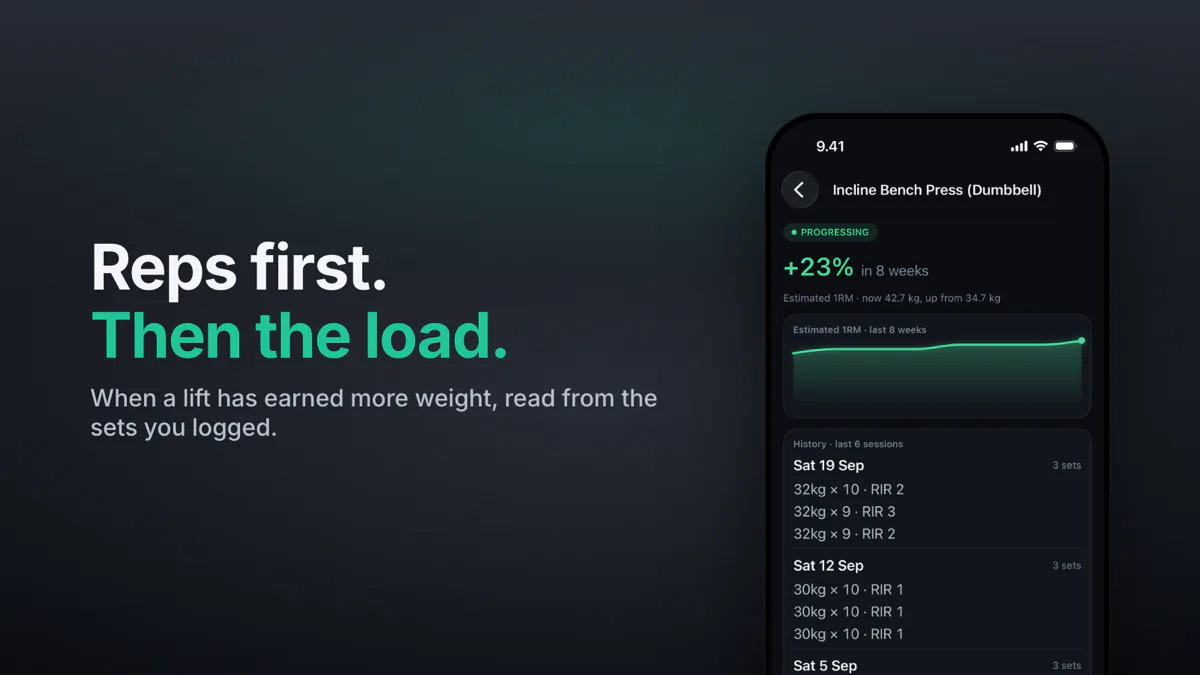
Progressive overload means doing a little more over time: more reps, more load or more sets. In Povver, reps go up first. The weight goes up once your log meets five conditions, and stays put while the lift is going backwards.
Reps or load
Plotkin, Schoenfeld and colleagues (PeerJ, 2022) took 43 lifters with at least a year of lower-body training and split them into two groups for eight weeks. One group added load at fixed reps. The other kept the load and added reps. Muscle growth came out about even: most sites differed by under a millimetre, and the rectus femoris grew slightly more in the reps group. Smith machine squat 1RM rose about 2 kg more with load, a gap the authors called "of questionable practical significance".
Refalo, Helms and colleagues (Sports Medicine, 2023) pooled 15 studies on how close to failure a set has to go. Going to failure gave a trivial edge for growth (effect size 0.19). When failure meant strictly momentary muscular failure, the edge was not significant (0.12).
So you can add reps before weight, and a set can stop short of failure.
RIR (reps in reserve) is how many more reps you had left at the end of a set, and RIR 0 is failure (Helms and colleagues, 2016).
Reps first, then weight
Povver runs double progression: add reps at one weight until your first set reaches the top of the rep range, then add weight. The reps usually dip after the jump.

In this example, the incline dumbbell press sat at 30 kg per hand for three weekly sessions, 29 August to 12 September. That is 14 days, right at the limit. Every first set reached 10, the top of its range, and the last set of the third session ended at RIR 1. The next session was at 32 kg: 10 reps on the first set, 9 on the other two.
The five conditions
After each session, Povver proposes more weight only when all five hold:
- At least three sessions at this weight (or within one step of it) in the last 14 days. Isolation lifts get 21 days. Machines and cables need two sessions in 21 days.
- Your last set ended at RIR 0 to 2 (0 to 3 on machines and cables).
- Your first set reached the top of the rep range.
- You completed at least 75% of the planned sets in at least three quarters of those sessions.
- At most one missed change on this lift in four weeks. A change counts as missed when you later lift under the new weight, or when half your sets or more fall short.
| Free weight | Machine or cable | |
|---|---|---|
| Sessions needed | 3 | 2 |
| Last-set RIR | 0 to 2 | 0 to 3 |
| Sessions needed in an accumulation block | 5 | 3 |
| Muscle already above its MAV | +1 session | +1 session |
| Deload week | no increase | no increase |
Log a compound lift without RIR and its weight never goes up: condition 2 needs that number. On isolation, machine and cable lifts, a blank RIR skips the check.
RIR sits in the grid next to weight and reps, prefilled from your plan or your last session. Change it to what the set felt like.

The extra session applies when the muscle a lift trains most is already past its maximum adaptive volume (MAV) that week. If the muscle is below its minimum effective volume, the lift progresses as normal, and what it needs is more sets.
When the weight holds
Two things hold the weight even when all five conditions are met:
- The lift is stalling: its estimated 1RM (e1RM, from the best set each week) has trended down 2% or more over six weeks and has not levelled off.
- The muscle the lift trains most is fatigued or overreached: its recent training load is more than 1.5 times its longer-term average (the acute:chronic workload ratio).

In this example, the bent-over row is stalling. Its estimated 1RM is down 14% in eight weeks, from 95 kg to 81.7 kg. The last three sessions were all at 70 kg, and the latest went 5, 5 and 4 reps with two sets at RIR 0. That first set is nowhere near the top of the range. Even if that set had reached the top of the range, the stall would still hold the weight.
A lift whose estimated 1RM has sat within about 4% for three weeks or more is marked holding (a plateau), even if it fell before that.
A holding lift that meets the five conditions still gets its increase.
Who makes the call
Povver checks all of this with arithmetic on your logged sets. The model proposes the new weight and writes the reason you see beside it, from those same numbers. With auto-pilot on, the engine caps the increase, rounds it to a weight you can load (your usual step when the log shows one, otherwise 2.5 kg, or 1.25 kg at 40 kg and under) and writes it into your plan.
With auto-pilot off, the proposal waits for you.
Sources
- Plotkin D, Coleman M, Van Every D, et al., Schoenfeld BJ, "Progressive overload without progressing load? The effects of load or repetition progression on muscular adaptations", PeerJ 2022. doi.org/10.7717/peerj.14142
- Refalo MC, Helms ER, Trexler ET, Hamilton DL, Fyfe JJ, "Influence of Resistance Training Proximity-to-Failure on Skeletal Muscle Hypertrophy: A Systematic Review with Meta-analysis", Sports Medicine 2023. doi.org/10.1007/s40279-022-01784-y
- Helms ER, Cronin J, Storey A, Zourdos MC, "Application of the Repetitions in Reserve-Based Rating of Perceived Exertion Scale for Resistance Training", Strength and Conditioning Journal 2016. doi.org/10.1519/SSC.0000000000000218
