You do not need to train to failure. A 2022 meta-analysis of 15 studies (Grgic) found no significant difference in strength or muscle size between sets taken to failure and sets stopped short. A 2023 meta-analysis of muscle size (Refalo) found at most a trivial edge for failure. A workable default is to stop one to three reps short on most sets.
What does training to failure mean?
Failure is the set where another rep will not come. Researchers call it momentary muscular failure: the muscles cannot produce enough force to move the load, however hard you try. Many lifters stop earlier, at the rep where form breaks. That is technical failure, and it usually arrives a rep or two sooner.
Reps in reserve (RIR) counts back from failure. RIR 0 is failure, and RIR 2 means two more reps were there. RPE vs RIR covers the scale.
Do you need to train to failure?
| Review | What it compared | Result | The catch |
|---|---|---|---|
| Grgic 2022, 15 studies | Failure against non-failure, strength | No significant difference (effect size -0.09, 95% CI -0.22 to 0.05) | In studies that did not match volume between groups, stopping short was ahead for strength (-0.32) |
| Grgic 2022, 15 studies | Failure against non-failure, muscle size | No significant difference (0.22, CI -0.11 to 0.55) | In resistance-trained lifters alone, a small edge for failure (0.15, CI 0.03 to 0.26). All participants were young adults |
| Refalo 2023, 15 studies | Any definition of set failure, muscle size | Trivial edge for failure (0.19, CI 0.00 to 0.37) | The interval only just reaches zero, so the edge is borderline |
| Refalo 2023, 15 studies | Momentary muscular failure only, muscle size | No significant difference (0.12, CI -0.13 to 0.37) | The authors found no evidence that momentary failure beats stopping short |
Standardised effect sizes from the abstracts of two meta-analyses of resistance-training trials, mostly in young adults: Grgic and colleagues (2022) and Refalo and colleagues (2023). A positive number favours training to failure. A confidence interval (CI) that spans zero means the difference is not significant.
Failure is optional. Where it helps, it helps a little.
How close to failure should you train?
Robinson, Zourdos and colleagues (Sports Medicine, 2024) asked how much proximity to failure matters, where the earlier reviews asked whether failure does. They estimated the RIR behind each study group and fitted outcomes to it. Strength gains were similar across a wide range of RIR, while muscle size grew more the closer sets ended to failure.
The authors call the analysis exploratory. Each group's RIR was estimated from how the training was described, so the shape of the curve is unclear, and Refalo's review points to a relationship that may not be a straight line.
Read plainly, strength does not need you close and muscle size rewards getting close. Povver's own judgment is that stopping one to three reps short on most working sets fits that; the studies do not name a range. Povver, a strength training app that reads your logged sets and sets your next weights, uses its own convention for weekly sets per muscle: a working set is hard at RIR 3 or lower. That is a counting rule, not a finding from the studies.
Does training to failure cost recovery?
It appears to. Pareja-Blanco and colleagues (Sports, 2019) had 17 men squat at 60% and 80% of 1RM, stopping each set at either 20% or 40% velocity loss, a bar-speed measure of how far a set drifts toward failure. The longer sets (40%) and the lighter load (60%) caused more fatigue and slower recovery, tracked for 48 hours. The study is small and covers one lift, and its yardstick is bar speed, not RIR.
A 2026 crossover study found the same pattern with sets taken to failure. Vieira and colleagues (Scientific Reports) had six trained men do two full-body sessions: one with every set to momentary muscular failure at their 10-rep max, and one with 10 reps at 85% of it. Total volume came out similar, and the failure session left more soreness and tissue-damage markers, and slower jump recovery through 72 hours. Six men is a very small sample, and the authors urge caution.
When does going to failure make sense?
No review ranks lifts for this, so this is Povver's judgment. Take a set to failure where bailing out is safe: the last set of a machine, cable or dumbbell isolation lift. On a heavy barbell squat or bench press, stop a rep or two short unless safeties or a spotter are set. Failure seems to cost recovery, so keep it to the few sets where it pays, and stop the rest short.
How accurate is your RIR?
All of this rests on a guess. Halperin and colleagues (Sports Medicine, 2022) pooled 12 studies of 414 people who predicted how many reps they had left and then went to failure. On average they were 0.95 reps short (95% CI 0.17 to 1.73): they had more left than they thought. Guesses were better close to failure and in sets that failed within 12 reps, and training status made no measurable difference.
On average, then, a set had about a rep more left than its rating said, with wide variation between studies and a smaller gap close to failure. The study-by-study spread is in RPE vs RIR. A rep either way is close enough to plan a session around, and any tool that takes your RIR at face value inherits that error.
How does Povver progress a lift you stop short on?
Each working set in your plan carries a target RIR, and a set with none is read as RIR 1. Ratings far from failure are the least reliable, so a target or a logged RIR above 4 is read as 4. Every set is judged against its own target, not against failure:
- Reps. A set that reaches its rep target at its target effort or easier goes up a rep next session. With more in reserve than the target, it goes up by the difference, up to three.
- Weight. The weight goes up after one session in which every working set is finished and the last set reaches the top of the rep range, counting any reps you had beyond the target RIR.
- Harder than planned. A working set more than one rep under its target RIR keeps the weight where it is, and a second one in a row at that weight drops it a step.
Take a bench press planned at 8 to 12 reps with a target of RIR 3. A last set of 12 at RIR 3 reaches the top, so the weight goes up, and so does 12 at RIR 4, which counts as 13 reps to target. A last set of 11 at RIR 2 counts as 10, so the rep target stays where it is. A last set of 12 at RIR 1 was two reps harder than planned, so the weight stays.

A lift planned at RIR 3 does not stall at the top of its rep range. It climbs on the same rules as one planned at RIR 1, set out in full in When should the weight go up? and on how it works.
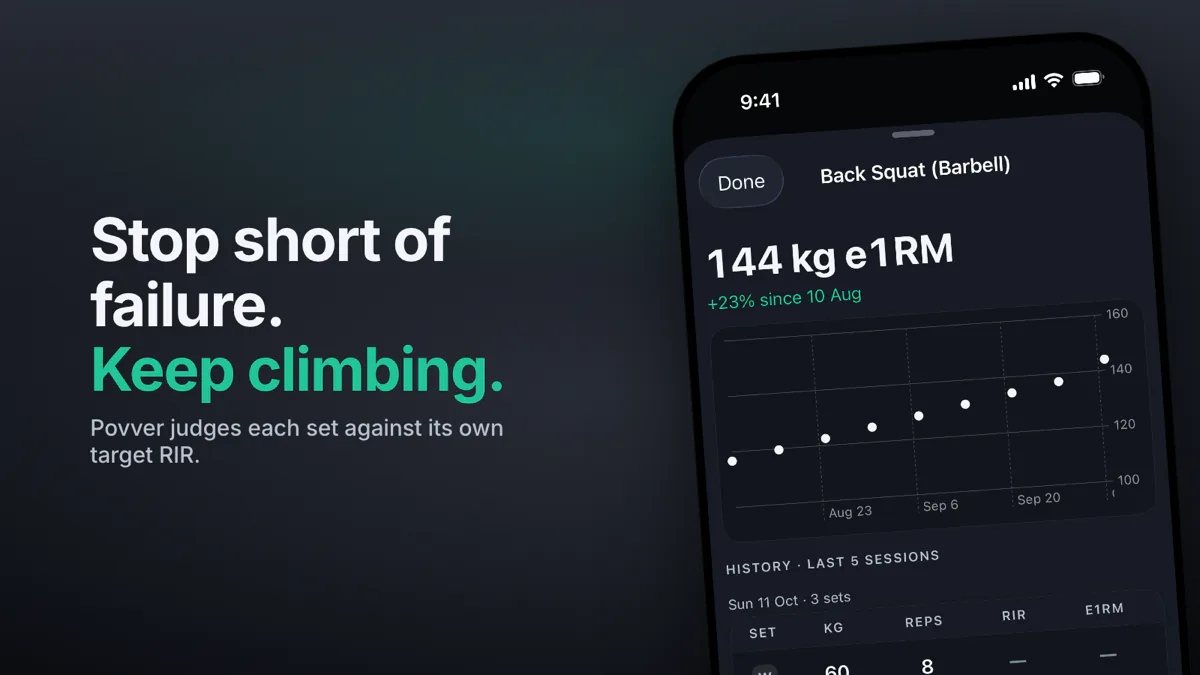
The estimated 1RM on a lift's page is worked out from the reps done, with no credit for reps left. A lift trained at RIR 3 reads below the true max, and its trend still rises when the lift does.
Training to failure: common questions
Should you train to failure?
Not as a rule. A 2022 meta-analysis of 15 studies (Grgic) found no significant difference in strength or muscle size between sets taken to failure and sets stopped short, and a 2023 meta-analysis (Refalo) found at most a trivial edge for muscle size. Failure is best kept for a few sets.
Does training to failure build more muscle?
Slightly, at most. A 2023 review of 15 studies found a trivial edge for set failure (effect size 0.19) and no significant edge for momentary muscular failure (0.12). A 2024 meta-regression found muscle size grew more the closer sets ended to failure, and its authors call the result exploratory.
Is training to failure better for strength?
Not in the evidence so far. In a 2022 review, strength showed no significant difference between failure and stopping short (effect size -0.09), and in the 2024 meta-regression strength gains were similar across a wide range of reps in reserve. Only in the studies that did not match volume did stopping short come out ahead for strength.
How many reps should you leave in reserve?
One to three on most working sets is a workable range, in the judgment of Povver, a strength training app. It stays close enough to failure for muscle size and leaves recovery for the next session.
When should you take a set to failure?
On the last set of a machine, cable or dumbbell isolation lift, where bailing out is safe, in the judgment of Povver, a strength training app. Failure costs recovery, so it suits a few sets.
Can you trust your RIR?
Roughly. Across 12 studies, lifters had about one rep more left than they predicted, with more accuracy close to failure. A rep either way is close enough to plan around.
Sources
- Grgic J, Schoenfeld BJ, Orazem J, Sabol F, "Effects of resistance training performed to repetition failure or non-failure on muscular strength and hypertrophy: A systematic review and meta-analysis", Journal of Sport and Health Science 2022. doi.org/10.1016/j.jshs.2021.01.007
- Refalo MC, Helms ER, Trexler ET, Hamilton DL, Fyfe JJ, "Influence of Resistance Training Proximity-to-Failure on Skeletal Muscle Hypertrophy: A Systematic Review with Meta-analysis", Sports Medicine 2023. doi.org/10.1007/s40279-022-01784-y
- Robinson ZP, Pelland JC, Remmert JF, Refalo MC, Jukic I, Steele J, Zourdos MC, "Exploring the Dose-Response Relationship Between Estimated Resistance Training Proximity to Failure, Strength Gain, and Muscle Hypertrophy: A Series of Meta-Regressions", Sports Medicine 2024. doi.org/10.1007/s40279-024-02069-2
- Pareja-Blanco F, Villalba-Fernández A, Cornejo-Daza PJ, Sánchez-Valdepeñas J, González-Badillo JJ, "Time Course of Recovery Following Resistance Exercise with Different Loading Magnitudes and Velocity Loss in the Set", Sports 2019. doi.org/10.3390/sports7030059
- Vieira JG, da Silva BP, Campos Y, et al., "Acute fatigue and recovery responses to resistance training performed to momentary muscular failure: an exploratory multimodal physiological study", Scientific Reports 2026. doi.org/10.1038/s41598-026-59113-6
- Halperin I, Malleron T, Har-Nir I, et al., "Accuracy in Predicting Repetitions to Task Failure in Resistance Exercise: A Scoping Review and Exploratory Meta-analysis", Sports Medicine 2022. doi.org/10.1007/s40279-021-01559-x
