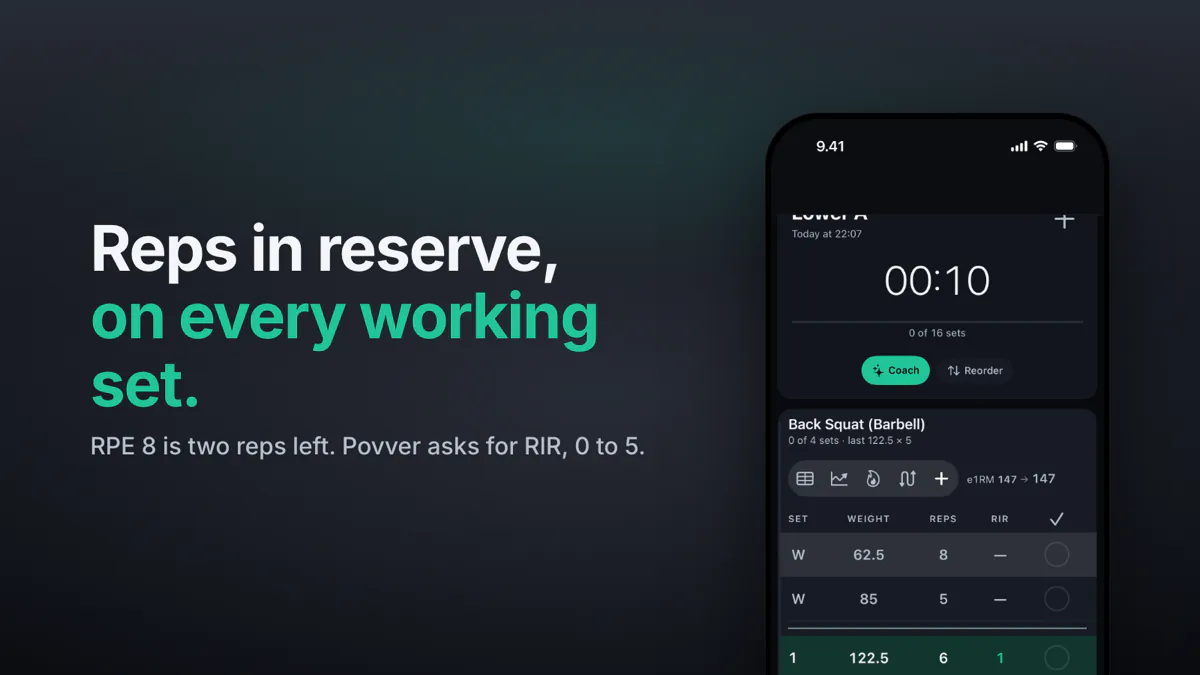
RIR (reps in reserve) is how many more reps you could have done when you racked the bar. RPE (rating of perceived exertion), on the scale lifters use, is 10 minus RIR. RPE 8 means two reps left and RPE 10 means none, so the two are the same scale. Lifters misjudge it by about a rep, and less the closer they get to failure.
One scale, two ways to write it
Zourdos and colleagues built the scale in 2016 by tying each RPE score to a count of reps left. The same year, Helms and colleagues wrote up how to program with it.
| RPE | RIR | The scale's wording |
|---|---|---|
| 10 | 0 | Maximum effort |
| 9 | 1 | 1 repetition remaining |
| 8 | 2 | 2 repetitions remaining |
| 7 | 3 | 3 repetitions remaining |
| 5 to 6 | 4 to 6 | 4 to 6 repetitions remaining |
| 3 to 4 | Light effort | |
| 1 to 2 | Little to no effort |
Below RPE 7 the scale uses ranges: RPE 5 to 6 covers 4 to 6 reps left.
Charts and programmes add half points. RPE 8.5 sits between one and two reps left, and a whole-number RIR has to round it one way or the other. Programmes written in RIR tend to give a range for this: "RIR 1 to 2" asks for the same effort as RPE 8.5.
RPE 8 and RIR 2 ask for the same set. Use whichever your programme is written in.
How accurate is RIR?
Halperin and colleagues (Sports Medicine, 2022) pooled 12 studies covering 414 people who guessed how many reps they had left and then kept going until they could not do another. On average the guess came in 0.95 reps short (95% CI 0.17 to 1.73): people had more left than they thought. The studies varied widely around that average. Guesses got slightly better near failure and in sets that failed within 12 reps, and training status made no measurable difference.
In Hackett and colleagues (JSCR, 2017), the error grew with the distance: lifters with 0 to 5 reps left were off by about one rep, and with 7 to 10 left, by more than two.
A bench press study shows what the miss looks like in trained lifters. Refalo and colleagues (JSCR, 2024) had 24 resistance-trained men and women press 75% of 1RM, and their calls were off by 0.65 reps on average (SD 0.78). Calls of 3 reps left were as good as calls of 1. All of them trained, all on one lift.
In one small study, six weeks of practice did not sharpen the calls. Nine trained men benched three times a week and called their reps left during their sets, and at the end they were no more accurate than at the start (Remmert and colleagues, 2023).
A rep either way is close enough to set a load by.
Far from failure the number means less. An RIR of 5 mostly tells you the weight was light.
Turning RIR into a load
Add RIR to the reps you did and you have the reps you could have done, which a 1RM formula turns into a share of your max. The RPE calculator uses Epley's formula: 5 reps at RIR 2 counts as 7 to failure, about 81% of 1RM.
Lifters spread widely around these charts. Nuzzo and colleagues (Sports Medicine, 2024) pooled the studies that tested reps to failure at a fixed percentage of 1RM. At 80%, lifters managed 9.75 reps on average, with a standard deviation of about 2.5 reps. The leg press ran to more reps than the bench press at every load, 13.1 against 8.8 at 80%. Helms and colleagues say the same of their own RIR chart: it should not be viewed as "an absolute conversion tool".
Use the chart for a starting weight, then adjust by the RIR your sets come in at. To estimate a max from one set, the 1RM calculator gives a likely range beside the number.
How Povver uses RIR
Povver asks for RIR, 0 to 5, on every working set. It sits in the set grid beside weight and reps, filled in from your plan or your last session, so you only touch it when a set felt different.

Which sets count. A hard set is a working set finished at RIR 3 or lower, and weekly volume per muscle counts hard sets. An easy set at RIR 5 adds nothing. A set logged without RIR counts as hard.
When the weight goes up. Your plan gives each set a target RIR. When a set reaches its rep target at that effort, its target rises by a rep the next session, and by up to three if you had more in reserve. The weight goes up after one session in which you finish every working set and your last set would have reached the top of the range at your target RIR. With a range of 8 to 12 and a target of RIR 1, 11 reps at RIR 2 counts as 12. The step grows with the reps you had left. It is always at least one increment, and otherwise no more than 10% of the load (5% on isolation lifts). Without RIR, the weight needs two sessions in a row at the top of the range.
A last set that comes in harder than planned, more than one rep under its target RIR, holds the weight. A second one in a row at that weight drops it a step.
A missed rep is quicker. One working set below the bottom of the range, and the next session starts a step lower.
Lifters tend to under-report reps left, so a wrong rating more often holds the weight back than raises it too soon.
Sources
- Zourdos MC, Klemp A, Dolan C, et al., "Novel Resistance Training-Specific Rating of Perceived Exertion Scale Measuring Repetitions in Reserve", Journal of Strength and Conditioning Research 2016. doi.org/10.1519/JSC.0000000000001049
- Helms ER, Cronin J, Storey A, Zourdos MC, "Application of the Repetitions in Reserve-Based Rating of Perceived Exertion Scale for Resistance Training", Strength and Conditioning Journal 2016. doi.org/10.1519/SSC.0000000000000218
- Halperin I, Malleron T, Har-Nir I, et al., "Accuracy in Predicting Repetitions to Task Failure in Resistance Exercise: A Scoping Review and Exploratory Meta-analysis", Sports Medicine 2022. doi.org/10.1007/s40279-021-01559-x
- Refalo MC, Remmert JF, Pelland JC, et al., "Accuracy of Intraset Repetitions-in-Reserve Predictions During the Bench Press Exercise in Resistance-Trained Male and Female Subjects", Journal of Strength and Conditioning Research 2024. doi.org/10.1519/JSC.0000000000004653
- Hackett DA, Cobley SP, Davies TB, Michael SW, Halaki M, "Accuracy in Estimating Repetitions to Failure During Resistance Exercise", Journal of Strength and Conditioning Research 2017. doi.org/10.1519/JSC.0000000000001683
- Remmert JF, Robinson ZP, Pelland JC, et al., "Changes in Intraset Repetitions in Reserve Prediction Accuracy During Six Weeks of Bench Press Training in Trained Men", Perceptual and Motor Skills 2023. doi.org/10.1177/00315125231189098
- Nuzzo JL, Pinto MD, Nosaka K, Steele J, "Maximal Number of Repetitions at Percentages of the One Repetition Maximum: A Meta-Regression and Moderator Analysis of Sex, Age, Training Status, and Exercise", Sports Medicine 2024. doi.org/10.1007/s40279-023-01937-7
