Men aged 20–29 tested by the Cooper Institute had a median bench of 1.06 × bodyweight: half benched more, half less. Strength Level puts the average man who logs his lifts there at 96 kg / 212 lb. Tested raw competitors in the 83 kg / 183 lb class have a median of 120 kg / 265 lb (OpenPowerlifting, 2016–2026).
How much can the average man bench?
About his bodyweight, in the Cooper Institute's norms for adults. Those norms, printed in ACSM's Guidelines, put the median man aged 20–29 at 1.06 × bodyweight and the median man aged 30–39 at 0.93 ×. For an 80 kg / 176 lb man in his twenties, that is about 85 kg / 187 lb.
People who train and log it lift more. Strength Level puts the average man at 96 kg / 212 lb, the middle of 9.9 million results from men. Among its results for 80 kg / 176 lb men, the middle one, stronger than half of the rest, is 98 kg / 216 lb.
Competitors lift more again. Among lifters who competed raw at drug-tested meets between 2016 and 2026, the median man in the 83 kg / 183 lb class benched 120 kg / 265 lb, and across all classes the median man benched 1.44 × bodyweight.
How much should I be able to bench for my bodyweight?
A bodyweight bench, 80 kg / 176 lb, beats 41% of Cooper-tested men in their twenties, 27% of Strength Level's results for men his weight and 5% of tested competitors in his class.
The table takes one 80 kg / 176 lb man and asks, at five bench weights, what share of each group he out-lifts. 41% means he benches as much as or more than 41 in every 100 people in that group. 50% is the middle of the group, and 90% puts him in its strongest tenth.
| kg / lb | Men, 20s | Strength Level | OpenPowerlifting |
|---|---|---|---|
| 60 / 132 | 7% | 8% | 1% |
| 80 / 176 | 41% | 27% | 5% |
| 100 / 220 | 74% | 52% | 21% |
| 120 / 265 | 91% | 75% | 51% |
| 140 / 309 | over 95% | 89% | 80% |
Share of each group that an 80 kg / 176 lb man benches as much as or more than, computed by Povver, September 2026. Men, 20s: men aged 20–29 tested by the Cooper Institute (ACSM Guidelines, 8th ed., Table 4.9). Strength Level: its row for 80 kg / 176 lb men, read 2026-09-27. OpenPowerlifting: tested raw lifters in its 83 kg / 183 lb class, 51,860 of them. Between the points each source publishes, the share is interpolated.
A 100 kg / 220 lb bench beats three in four Cooper-tested men in their twenties and one in five tested competitors in the 83 kg / 183 lb class (OpenPowerlifting, 2016–2026).
Try your own numbers in the strength standards calculator, which places a lift among tested competitors in your weight class.
What is a good bench press?
For a man, 1.25 × bodyweight beats about three in four men in their twenties in the Cooper data and about half of Strength Level's results for men his weight. For a woman, 0.8 × bodyweight beats four in five women aged 20–29 in the Cooper data.
Among competitors, "good" starts higher: the median tested man benches 1.44 × bodyweight, and Povver's calculator calls a bench advanced once it reaches the median of the tested lifters in your class.
Average bench press for women
The median woman aged 20–29 in the Cooper data benched 0.65 × bodyweight, and the median woman aged 30–39 benched 0.57 ×. Strength Level puts the average woman at 51 kg / 112 lb, the middle of about one million results from women. Among tested raw competitors, the median woman benched 0.88 × bodyweight.
| kg / lb | Women, 20s | Strength Level | OpenPowerlifting |
|---|---|---|---|
| 30 / 66 | 15% | 19% | 2% |
| 40 / 88 | 53% | 37% | 11% |
| 50 / 110 | 85% | 55% | 33% |
| 60 / 132 | 95% | 71% | 60% |
| 75 / 165 | over 95% | 86% | 87% |
Share of each group that a 60 kg / 132 lb woman benches as much as or more than, computed by Povver, September 2026, from the same three sources: Cooper Institute women aged 20–29, Strength Level's row for 60 kg / 132 lb women, and OpenPowerlifting's 63 kg / 139 lb class, 19,837 lifters.
A bodyweight bench, 60 kg / 132 lb, beats 95% of women aged 20–29 in the Cooper data and 60% of tested competitors in the 63 kg / 139 lb class.
Why the three averages disagree
Each one counts different people and tests them differently.
Adults tested by the Cooper Institute. It stands in for the general population here. ACSM reprints the table with permission from the Cooper Institute in Dallas: 6,106 men and 1,154 women from under 20 to over 60, 425 of the men and 191 of the women aged 20–29. The ratio is pounds pushed over bodyweight in pounds. ACSM's table does not name the equipment. FitnessNorms, which summarises the Cooper Institute's own norms book (2013), reports a Universal machine and Cooper Clinic patients, a self-selected group rather than a random sample of adults. A machine press is not a free-weight bench, so read these numbers as a rough guide.
Gym-goers. Strength Level's numbers are lifts its users entered themselves, 10.9 million results kept after checks for implausible and duplicate entries. Nobody watches the rep. Its calculator takes weight and reps, so many results are estimates from a set, not tested maxes, and one user can log many results.
Competitors. OpenPowerlifting records lifts passed by referees at meets: the bar paused on the chest and pressed to lockout, with no bench shirt in the raw division. The catch is who competes: people who chose to enter a meet, and a lifter who cuts weight before one lands in a lighter class than their usual bodyweight.
Pick the population you want to be measured against.
How Povver tracks your bench
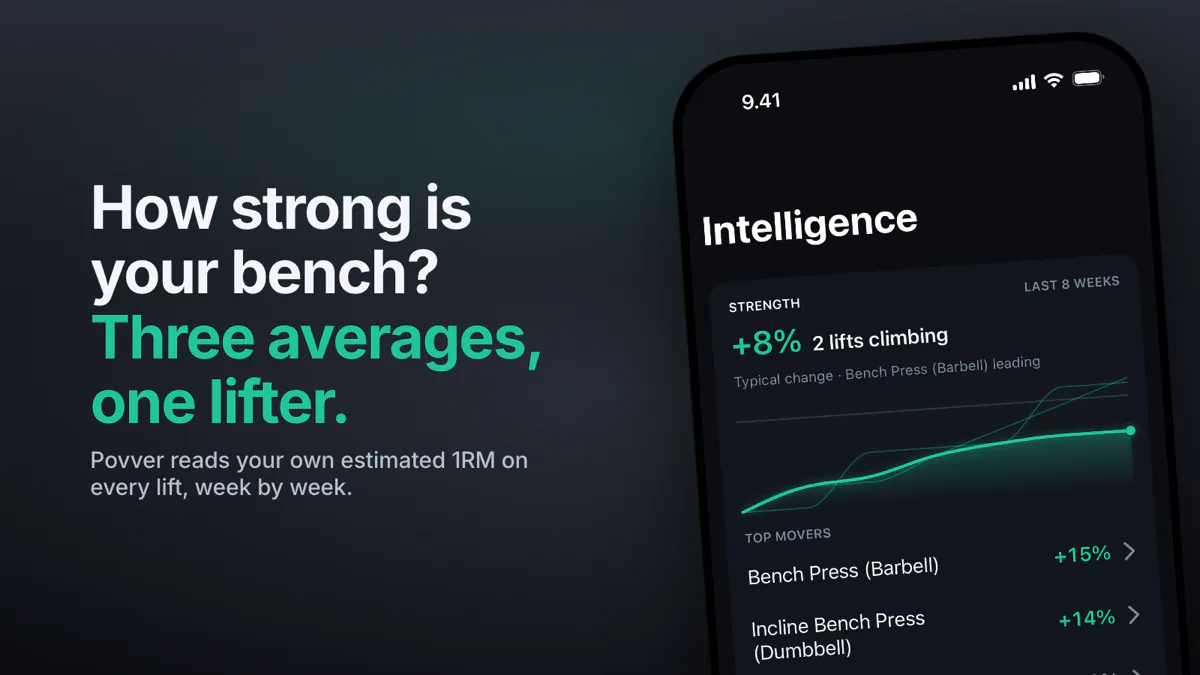
Povver compares your bench with your own last eight weeks. It estimates a 1RM from every working set you log, using Epley's formula on your reps plus your reps in reserve, and takes your best set each week. The Intelligence tab labels each lift climbing, maintaining or declining from that weekly line. 1RM formulas compared covers the formula and how far to trust it.
For a comparison with other lifters, the strength standards calculator runs the competitor numbers for your sex, bodyweight and lift.
Sources
- American College of Sports Medicine, "ACSM's Guidelines for Exercise Testing and Prescription", 8th edition, Table 4.9 Upper Body Strength (Cooper Institute norms), Lippincott Williams & Wilkins 2010.
- Strength Level, "Bench Press Standards", read 2026-09-27. strengthlevel.com/strength-standards/bench-press/kg
- OpenPowerlifting, meet results 2016-09-20 to 2026-09-20, as built for Povver's strength standards tool. www.openpowerlifting.org
- FitnessNorms, "Cooper Institute bench press norms", on the equipment and sample behind the Cooper table. fitnessnorms.com/strength/cooper-bench-press/
